


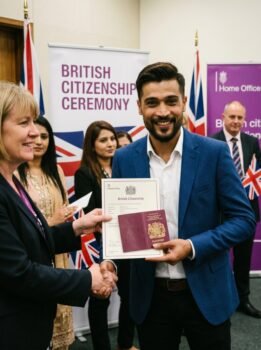

He Can’t Play for Pakistan Anymore. But He Can Play in the IPL. Mohammad Amir Just Changed Cricket’s Borders Forever.
Nineteen years. That’s how long Pakistan’s players have been frozen out of the IPL. On Monday, one signature on a piece of paper — a British passport — may have melted that freeze. Mohammad Amir is now a British citizen. He is now eligible for the IPL. And the cricket world is asking one question: will a franchise have the nerve to pick him?
The Paperwork That Changes Everything
The news broke on May 20, when Amir shared an Instagram story confirming his change in nationality status. A new journey starts for Mohammad Amir as he officially became a British citizen today and received his passport. The legal pathway was straightforward: his wife, Narjis Khan, is a British national. Under UK law, spouses of British citizens can apply for naturalisation after meeting residency requirements. Amir had been in the process for over a year and had publicly hinted at the timeline during an appearance on the Pakistani chat show ‘Haarna Mana Hai’ in early 2025.
“By next year, I will have the opportunity to play in the IPL, and if given the chance, then why not? I will play in the IPL,” Amir had said. That “next year” is now. The British passport removes the single largest obstacle that has kept Pakistani cricketers out of the IPL since 2009 — the requirement for a No Objection Certificate from the Pakistan Cricket Board, which the PCB has refused to issue since the Mumbai terror attacks.
◆ The Azhar Mahmood Precedent
The only Pakistan-born cricketer to have played in the IPL after the ban is Azhar Mahmood. After acquiring British citizenship, Mahmood represented Punjab Kings in 2012 and 2013 and Kolkata Knight Riders in 2015 — registered as an English player, not a Pakistani one. The BCCI’s rule is nationality‑based, not birthplace‑based. Amir’s UK passport places him in exactly the same legal category as Mahmood was.
What Amir Brings — And the Risks
At 34, Amir is no longer the express quick who tormented India in the 2017 Champions Trophy final. But he remains a highly skilled left-arm swing bowler with experience across 36 Tests, 61 ODIs and 62 T20Is. He can swing the new ball prodigiously, has developed a reliable yorker for the death, and has extensive franchise experience in the PSL, BBL, CPL, and The Hundred. “Amir is still one of the best new-ball bowlers in T20 cricket. On a helpful surface, he is a genuine wicket‑taker,” a franchise scout told this publication.
The risks are equally significant. Amir’s career has been shadowed by the 2010 spot‑fixing scandal, for which he served a prison sentence and a five‑year ban. He is also no longer an active international cricketer, having retired from Pakistan duty for the second time after the 2024 T20 World Cup. Any franchise bidding for him would face intense scrutiny — from fans, media, and potentially the BCCI itself. But IPL franchises have shown before that they value proven match‑winners, and Amir is undeniably that.
The BCCI Question — Will They Allow It?
Legally, Amir is eligible. But the IPL is not only a legal entity — it is also a political one. The BCCI’s stance on Pakistan‑born players has been consistent since 2009: no participation. However, the Azhar Mahmood precedent proves that the board does not block players based on birthplace if they hold non‑Pakistani citizenship. Whether the BCCI would treat Amir — a far more high‑profile and controversial figure than Mahmood — the same way remains an open question. There has been no official statement from the BCCI on Amir’s case as of publication.